What Is Pallet Racking? A Complete Guide to Types, Parts & Capacity
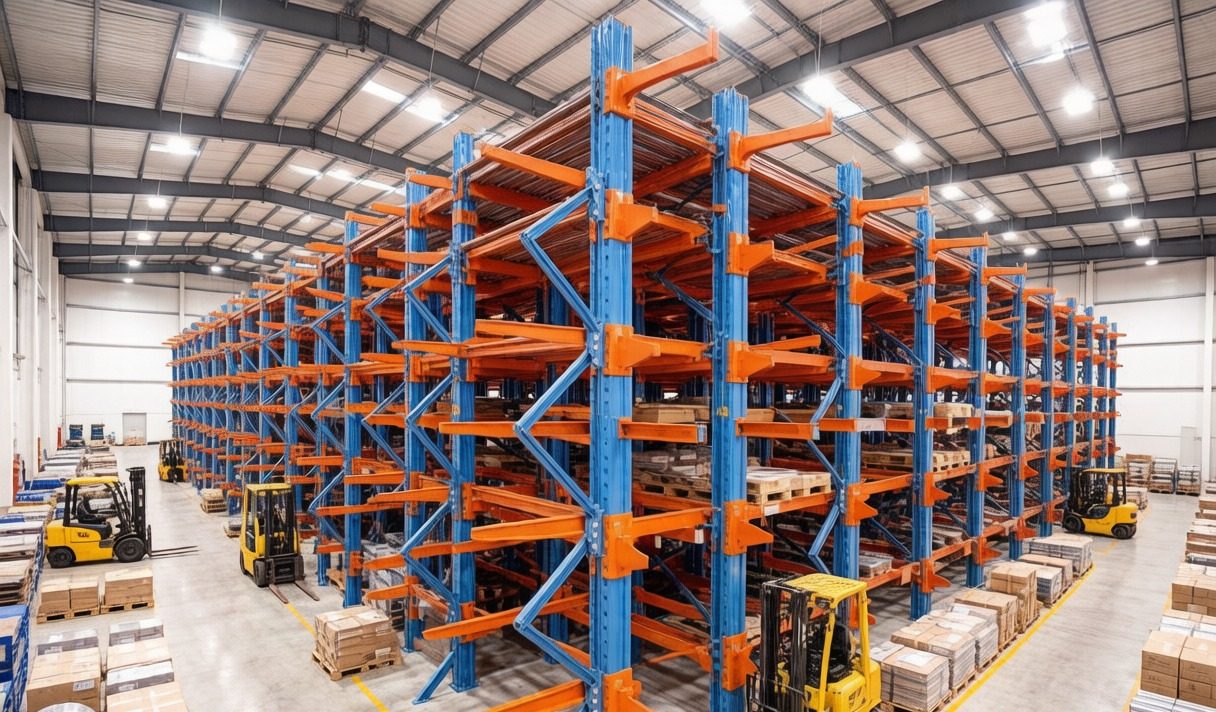
Pallet racking is the quiet workhorse of almost every distribution centre, cold store and manufacturing plant on the planet. If your business moves goods on pallets, the system that stores those pallets is doing more than holding weight — it is organising your entire operation. This guide explains what pallet racking is, the parts it is made of, the main types available, how load capacity works, and how to pick the right system for your warehouse.
What Is Pallet Racking?
Pallet racking is a multi-level steel storage system designed to hold unit loads — goods grouped on standard pallets — so they can be placed and retrieved by forklift. Rather than stacking pallets on the floor (which crushes the bottom load and wastes vertical space), racking builds upward in a rigid frame of vertical uprights and horizontal load beams.
The concept is simple but powerful: group products into palletised unit loads, then store those loads on adjustable shelves served by aisle-running forklifts. The idea matured during the Second World War to streamline transport and was originally built from wood; today it is almost entirely roll-formed or structural steel engineered for heavy, repetitive loads.
Why Pallet Racking Matters
A well-designed racking system pays for itself many times over. The main advantages:
- Maximum use of cubic space. Floor area is expensive; racking converts empty air into usable storage and can double or triple capacity without a bigger building.
- Direct access and fast picking. Selective systems give 100% access to every pallet, so forklifts spend less time hunting.
- Flexibility to grow. Adjustable beams let you reconfigure bay heights as your pallet mix changes — no new racking.
- Better inventory control. Pallet positions map cleanly to SKUs, simplifying cycle counts and stock rotation.
- Safety. Engineered frames, load notices and protectors reduce the collapse and damage risk of floor-stacking.
- Lower handling cost. Compact, organised storage cuts travel time, damage and labour per pallet moved.
Core Components of a Pallet Racking System
Most systems share the same building blocks:
- Uprights / frames. Vertical columns with punched holes (teardrop or keyhole) that accept beam connectors. They carry the entire vertical load.
- Load beams. Horizontal members, usually a pair per level, that support the pallets. Beam capacity depends on profile, length and connection.
- Footplates / baseplates. Welded plates at the base of each upright, bolted to the floor with anchor bolts to resist overturning and impact.
- Decking. Wire mesh shelves, timber or pallet supports that keep pallets and loose cartons from falling through.
- Column protectors. Guards bolted to the floor in front of uprights to absorb forklift knocks.
- Row spacers & wall ties. Braces that tie back-to-back rows together for stability.
- Diagonal & horizontal braces. Bolted between uprights to form a rigid frame.
Why Anchoring to the Floor Is Non-Negotiable
Uprights must be secured to the concrete slab with certified anchor bolts. A free-standing rack can be pulled over by a single forklift impact or by seismic and wind loads. Proper anchoring, correct torque and an intact baseplate are what turn a stack of steel into a structural system. Most racking is roll-formed (teardrop) steel for cost and flexibility, while structural steel is used where durability and heavy abuse are expected.
The Main Types of Pallet Racking
Choosing a system starts with one question: do you need access or density? That splits racking into two families — selective (direct access) and compact (high density). Here are the systems you will actually specify.
1. Selective (Adjustable) Pallet Racking
The most common racking in the world. Forklifts run parallel to the rows and every pallet is reachable from the aisle. It offers 100% selectivity, simple layout and easy reconfiguration — at the cost of aisle space. See our selective pallet racking →
2. Very Narrow Aisle (VNA) Racking
An adaptation of selective racking with aisles squeezed to the width of a guided reach truck. You keep 100% direct access but reclaim much of the floor lost to wide aisles. Requires specialised VNA forklifts and a flat, guided floor.
3. Double Deep Racking
Two pallets deep per location. You gain roughly 30–40% more capacity than selective, but the rear pallet is only reachable after the front one moves — a small selectivity trade-off for a big space win. Explore double deep racking →
4. Drive-In & Drive-Through Racking
High-density systems where forklifts enter the rack structure itself. Drive-in uses a single entry/exit and works LIFO (last-in, first-out) — ideal for bulk, low-turn stock. Drive-through has openings at both ends for FIFO rotation. Capacity is excellent; selectivity is low and uprights see more impact. See drive-in racking →
5. Pallet Flow (Live Storage)
Pallets ride on slightly inclined roller beds from the load face to the pick face. It is a FIFO system — first pallet loaded is first retrieved — giving perfect stock rotation for food, pharma and date-sensitive goods. See gravity / flow racking →
6. Push-Back Racking
Similar wheeled beds to flow, but LIFO: loading a new pallet pushes the others back. Higher density than selective with faster throughput than drive-in, because the forklift stays at the aisle face. Good for bulk SKUs with limited variety.
7. Mobile Racking
Racking mounted on floor rails that slide sideways to open a single working aisle on demand. Almost the entire floor becomes storage; access is slower but density is maximal. Popular in cold stores and archives where space is at a premium. See mobile racking →
8. Cantilever Racking
Instead of beams, horizontal arms project from a single upright — perfect for long, awkward loads: lumber, pipe, steel bar, furniture and timber. No front column means uninterrupted loading by side-loader or crane. See cantilever racking →
9. Shuttle & Automated (AS/RS)
Semi- and fully-automated systems use a radio-controlled shuttle or stacker crane to place pallets deep without a forklift entering the lane. Highest density and throughput for high-volume operations; we cover the shuttle vs drive-in trade-off in our comparison article →.
Selective vs Compact: Which Family Fits You?
If floor space or per-square-metre rent is your constraint, compact systems (double deep, drive-in, flow, push-back, mobile, shuttle) win on density. If pick speed and 100% access matter more than squeezing every cubic metre, selective or VNA is the answer. The right call depends on your SKU count, rotation and forklift fleet — our full selection framework → walks through it step by step.
Understanding Pallet Rack Load Capacity
Capacity has two parts, and you must size both:
- Beam capacity — the load a pair of beams safely holds per level. Rule of thumb: load per pallet position × positions per level.
- Frame (upright) capacity — the total vertical load each upright carries: beam capacity per level × number of levels.
Deflection matters too. Under RMI (Rack Manufacturers Institute) rules, a beam may deflect no more than L ÷ 180 of its length — a 96-inch beam sags at most about 0.53 inches under load.
Pallet Rack Safety & Standards
Racking is a structural system and degrades like any other. Capacities in the major standards — RMI (USA), FEM (Europe) and AS4084 (Australia) — assume evenly distributed loads, correct spacing, anchoring and sound pallets. Real warehouses rarely stay ideal, so a disciplined inspection routine (daily operator checks, monthly supervisor walks, annual qualified inspection) is essential. Our warehouse racking safety inspection checklist → lays out exactly what to look for.
How to Choose the Right System
Start from the SKU and the forklift, not the catalogue: count SKUs and pick frequency, decide FIFO vs LIFO, match the rack to your truck fleet, factor in cold storage, and design for where volume will be in three years. Send us your layout and we will return a free, engineered design — or open the calculator above to size capacity first.
Frequently Asked Questions
What is pallet racking used for?
It stores palletised unit loads on multi-level steel frames accessed by forklifts, maximising vertical space while keeping every pallet reachable and inventory organised.
What is the difference between selective and drive-in racking?
Selective gives 100% direct access to each pallet but lower density; drive-in stores pallets several deep for high density and works LIFO, so the rear pallet is reached only after the front one is moved.
How is pallet rack load capacity calculated?
Beam capacity = load per pallet position × positions per level. Frame capacity = beam capacity × number of beam levels. Always confirm against published ratings and a qualified engineer's drawings.
What standards govern pallet racking?
RMI (United States), FEM (Europe) and AS4084 (Australia) define capacity, deflection limits (commonly L/180) and safety requirements for industrial racking.
Do pallet racks have to be bolted to the floor?
Yes. Uprights are anchored with concrete anchor bolts so the system resists forklift impact, seismic and overturning loads. Unanchored racking can be pulled over by a single impact.
Open the Load Capacity Calculator → Get a free racking design